Colonial Gardening
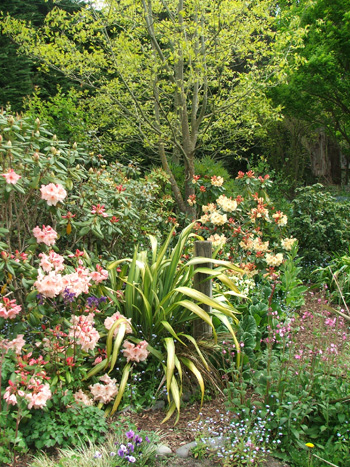
Rhododendrons and Phormium
One of my British gardening friends (Vic in Sussex) asked me to write a small piece about gardening in New Zealand. Seems an easy enough thing to do, but there's a small matter of the colonial inferiority complex. 'Down under' can imply lower in rank, unless it refers to Australia and cricket - but that's another story...
I've always imagined that grey British winters would force a British gardener indoors, writing detailed lists, creating seasonal plans and growth charts, totally prepared for anything the spring, summer, and autumn bring. Colonial gardeners like me, out in the garden all year round, could be forgiven for their lack of organisation. Finding enough things to do in the glass-house when it's raining is my only problem.
New Zealand Style
Is there a New Zealand gardening style? I wouldn't want anyone to think that New Zealand gardeners have no style at all. We have rhododendron festivals in spring. We grow delphiniums (except I've just ripped out all my blue beauties - they have no idea of wind survival). The big glossy Ellerslie Flower Show tried for years to rival its English counterparts, but including and celebrating Pacific designer influences.
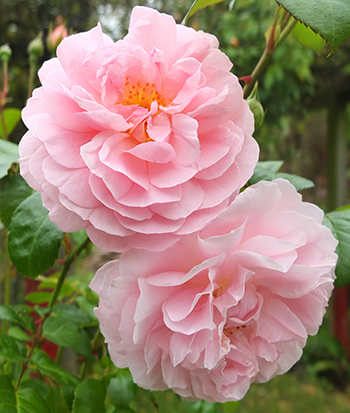
Strawberry Hill Roses
Yeay for David Austin!
And we're still going potty over David Austin's English roses - never mind that they all end up spread-eagled, spotty and lanky, with the demeanour of American basket-ballers. Well, the early variety called Heritage certainly did. I threw all mine out.
All New Zealand gardeners garden with the wind. Shelter belts in country gardens like mine protect the home, garden, and stock, and are a fact of life. There is no place for false snobbery concerning rows of Leyland Cypresses. The wind blows nearly every day, tickling the flaxes and tussocks of sensible garden designs and shredding the Japanese maples of others less sheltered.
Blowing in the Wind
There is a wind from every compass direction to blow down the delphiniums and foxgloves. Tough country trees like the Australian Eucalyptus are coyly said to be self-pruning. In my garden the Wattle Woods (a tranquil place of mottled greenery and gently winding paths) become a hard hat area when the Norwester blows. The big gum trees near the house create the ambience of a down-town bus depot when these winds are strong - it becomes too noisy to think, let alone talk.
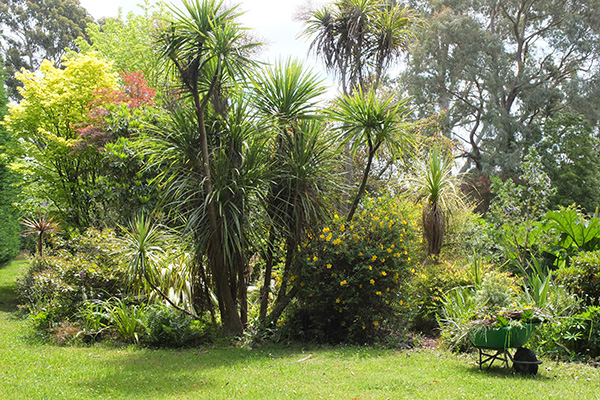
Wheelbarrow on Duck Lawn
Genuine Allotment gardening is rare, since the tradition in New Zealand has been for many years to own one's home and a quarter acre of land. But there are some beautiful Community Gardens in the suburbs of towns. Both urban and rural gardens are built around the house, with courtyards, barbecues, decking and outdoor dining suites. And sheds!
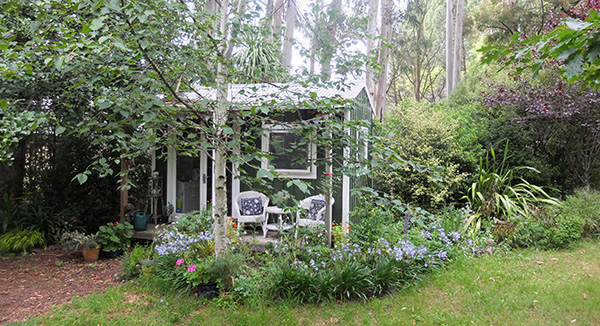
Cottage in the trees
We all cherish our garden sheds. Some country colonials, like myself, have more than one (I have a pump-house, a hen house, a glass-house, and a wee garden cottage). These are cherished, used, and much photographed for their rough, rustic charm. They are creative spaces, often filled with seedlings and pots, or garden tools, or (in the case of my cottage) a cosy bed, bookcase, and armchair.

Irises and Flax
Lettuces for the Girls
Tomatoes, potatoes and peas used to be the traditional old-school bloke vegetable crops, while girly gardeners grow gourmet lettuces and assorted salad greens. My vegetable garden ends up in the summer sun full of colourful lettuce trees and voluptuous oversized marrows.
New Zealand shrubberies...
New Zealand shrubberies have an amazing collection of native evergreens to choose from. I grow them all - particularly Pittosporums, Pseudopanax, Hebes, Corokias, and Coprosmas. Mixed borders can happily include native spiky plants - Toe Toe, Cordylines (which we call Cabbage Trees), and definitely some Phormiums (flaxes). We also grow many Australian shrubs and trees. My garden has some wonderful huge Eucalyptus trees on its boundaries, plus one right smack bang in the middle of the house lawn. A beauty!

Toe Toe in a mixed border
Cabbage trees, Phormiums, Toe Toe...
In my garden, red and green Cabbage trees flourish surrounded by roses and perennials. Phormiums sit side by side with elegant Rhododendrons. Toe Toe plumes are spectacular waving in the wind - and New Zealand is a rather windy island. Our hybrid Phormiums are fully hardy here - and spectacular when in flower. They also attract native nectar-drinking birds, thus proving we are environmentally aware as well as having a natural pride in our home-grown flora. Ha!
And New Zealander gardeners tend to use grasses really well, for colour and texture. Perfect for showing off that blasted wind! Tussocks of every size, colour, and form are popular (and cheap).
Pacific Perceptions
But it's all a matter of perception. Any New Zealand coffee table gardening glossy will talk of a discernible Pacifika style. When I wander outside and look around my garden I'm just not so sure. Seems that for all the bravado, it's just a bit of a mess.
Or, looking at it another way, the perfect blend of old 'mother country' gardening culture with the indigenous greenery. Nice!