Early Days in the Jelly-Bean Border
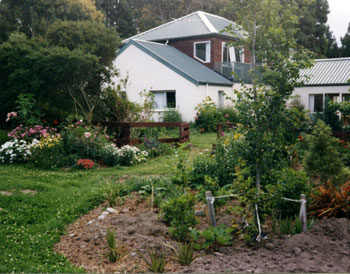
The Jelly-Bean Border
Early in its life the Jelly Bean Border was definitely shaped like a Jelly Bean - hence its rather descriptive name. This was one of my earliest borders. I started digging it in the paddock lawn in my first and second summers at Moosey's.
I wanted to create a shrubby windbreak for the Pond Paddock. I shifted in a sad young elm tree (suffering out by the roadside) and found several Viburnum tinus shrubs to form the backbone of the border.
Borrowed Shrubs
Tough shrubs 'borrowed' from other places soon followed - Senecio, Hypericum, Cordylines, Phormiums (species varieties) and Berberis. And of course I bought and planted more trees - a tulip tree and a Liquidamber.
Early roses...
The Jelly Bean Border joined a narrow curved side house garden, with an original sheep fence between. Originally this had been planted with alternating bright red Dublin Bays and white Icebergs.
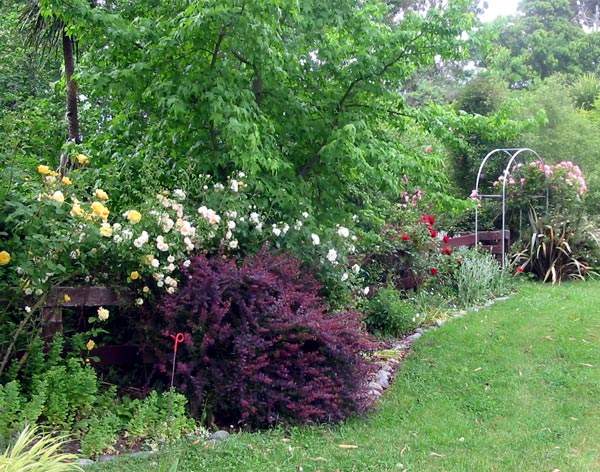
roses along the fence-line - summer 2003
I added more roses - Phyllis Bide, and a clutch of Graham Thomases, and planted what I thought were complementary shrubs in-between.
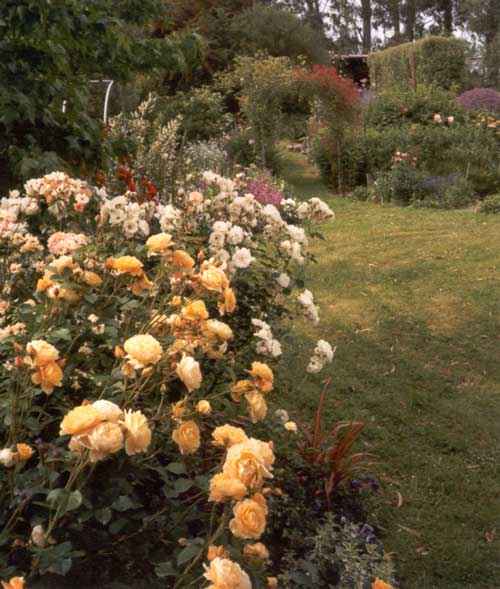
roses along the fence-line - summer 1998
My early photographs show masses of flowers on strong, healthy shrubs. The Jelly Bean Border was so much sunnier then, as the newly planted trees were only juveniles.
More shade...
But pretty soon, with increased shade, shrub growth, (and some neglect), the roses stopped thriving. I shifted some out into other gardens, while Dublin Bay, which in my garden was very rust-prone, was thrown on the bonfire. Such a pity!
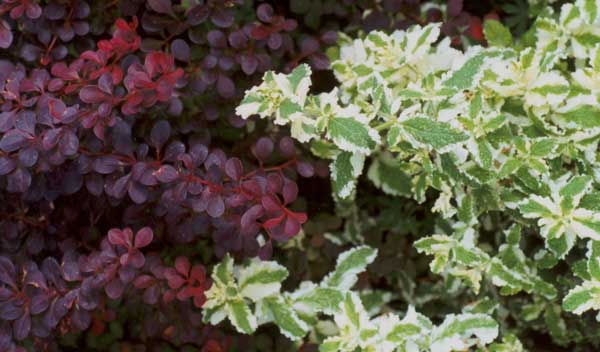
berberis and mint
Various smaller plantings came - unfortunately many didn't last very long. A patch of apple mint survived for a few years, jostling for space with the ever-expanding Berberis. Naturally, the Berberis won! In spring 1998, I planted Hostas and Primroses on the shady side of the Jelly Bean Border. Oops - not a suitable location. It was too dry, and they were smothered by ferns.
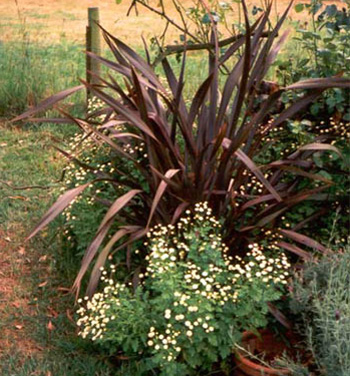
Feverfew and Bronze Phormium
The pretty perennial Feverfew used to grow alongside an original species Phormium in the top corner. There was even enough sun for some irises and dahlias. They are long gone.
Flattened
As is that first big bronze Phormium. It was flattened in a snow storm and had to be dug out. Such a pity - in summer it used to combine so well with the yellow Graham Thomas roses and the daisies beneath - the effect was a bit of colour magic.
I replanted a smaller flax, but it didn't have the rich bronze tones. It's survived, though. Phormiums are tougher that roses?
The BIG GUM, one of the original trees in the nearby house lawn, is a feature which is still growing strong. It's noisy in the wind and is always dropping leaves and bark, but I love this tree.

The Jelly Bean Border in Autumn
The top of the Jelly Bean Border is fenced at its boundary with the ram paddock, planted with large species Phormiums - not the most suitable varieties for an ornamental garden. My early plans for expanding into the ram paddock fell upon deaf ears.
Nowhere to go!
So the Jelly Bean Border was doomed to be a garden area that couldn't really go anywhere. Which was probably just as well.